A driveway briefing in Newcastle is not a colour chart and a handshake. It is a set of questions about how a truck will reach the forms, where the water will go after an east-coast low, and who owns the last four metres of concrete before the kerb. Get those answers on paper and the pour is a day's work. Skip them and you inherit a slab that ponds against the garage door, or a verge that council will not accept.
This essay sits at the front of the driveways and crossovers hub because the later arguments — finish, slope, pavers, width — all rest on the same week of planning. Read it as a briefing note, then take it to the yard.
The truck has to reach the forms
Ready-mix is cheap only while it stays in the barrel. Once the driver has to idle in a Hamilton laneway, or the crew has to barrow thirty metres because a jacaranda and a parked ute have closed the street, the quote you accepted on the phone is already wrong.
Mixer, pump or barrow
Walk the route before anyone prices the job. A mixer needs roughly three metres of clear width and a firm standing place that will not chew the verge into a bog. If the barrel cannot get within a few metres of the pour, you are buying a pump, a barrow line, or a smaller load and a second truck. On a tight Cooks Hill terrace that is ordinary. On a new estate at Fletcher or Medowie it should be unnecessary, which is why a quote that assumes street access is not interchangeable with a quote that assumes a pump.
Check overhead lines, street trees, and the day of the week. A school-zone morning on a Port Stephens cul-de-sac is a different job from a Tuesday in Hexham. If the crew cannot tell you how the concrete will arrive, they have not looked at the block.
Fall is not a preference
Water has to leave the slab. In this climate that is not a slogan. Newcastle, Lake Macquarie and the lower Hunter take east-coast lows that can put fifty millimetres on a driveway in an afternoon. If the slab falls toward the house, the garage becomes a sump. If it is dead flat, the same water sits, evaporates and leaves a lime bloom that people then blame on the mix.
A working rule is a fall of about one in eighty away from the dwelling — twelve millimetres in a metre — toward the street, a spoon drain, or a pit that actually connects to something. On a rising block that is easy. On a falling block it is the whole design. Sloping driveways and drainage on Hunter blocks is the essay for those sites. Do not let a crew “make it work” with a single plane that aims stormwater at the neighbour's rose bed. The National Construction Code's drainage logic, put in ordinary language, is that surface water from your work should not become someone else's problem.
A driveway that looks level is often a driveway that will pond. You want to see the fall with a straightedge and a spirit level, not with hope.
Thickness, steel and the joints that save the slab
For cars on a compacted base, 100 millimetres of concrete is the Hunter default. If the household runs a van, a boat trailer or a tradie's trayback, 125 millimetres is the number that belongs in the quote. Thickness is not a virtue by itself. A 150 millimetre slab on loose fill will still crack. A 100 millimetre slab on a well-compacted gravel or crushed-rock base, with steel in the right place, will outlast the car.
Mesh, chairs and the crack you choose
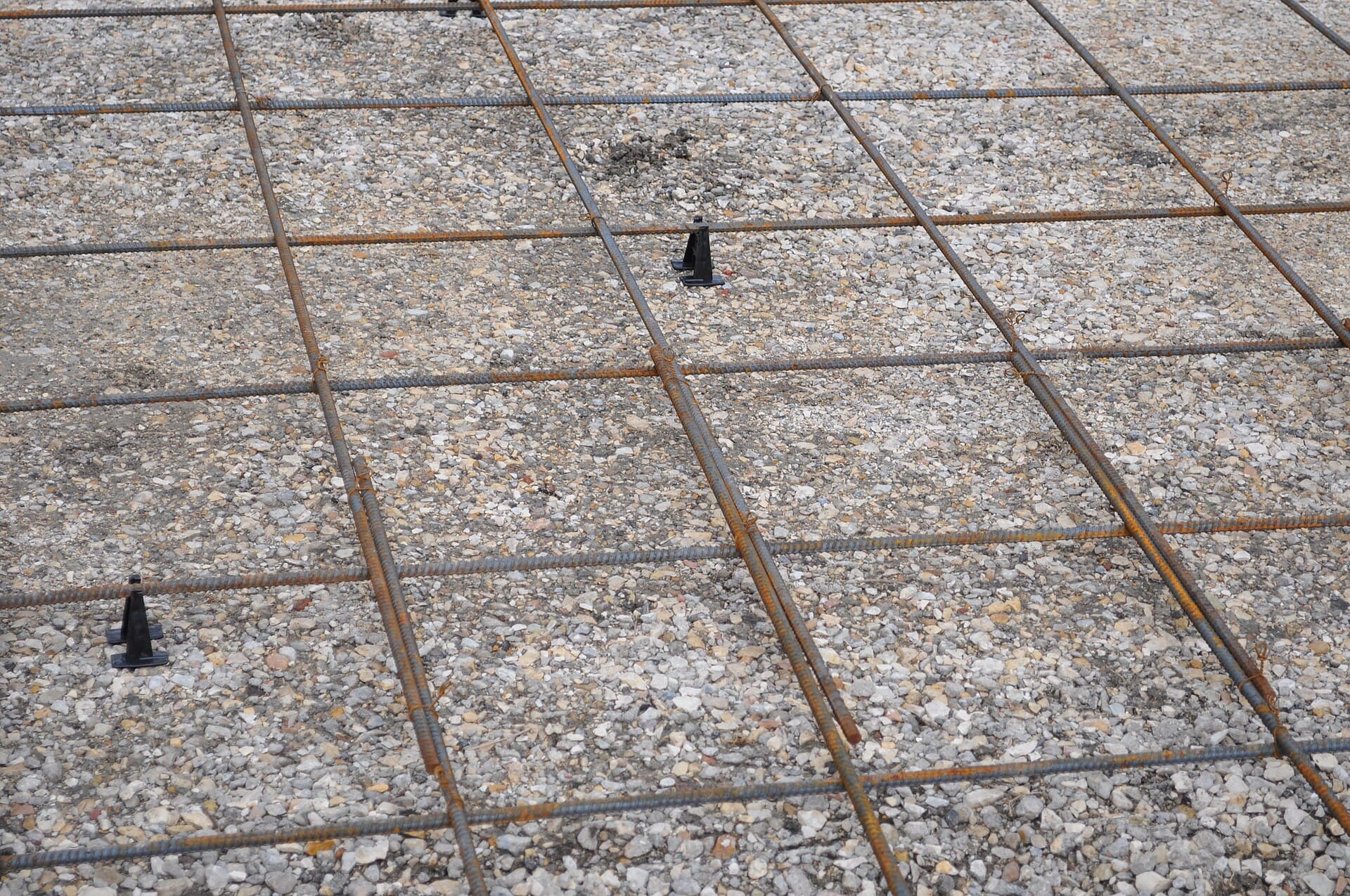
SL72 mesh — 6.75 millimetre bars at 200 millimetre centres — is the sheet most residential driveways here still get. Some crews use a heavier fabric or a bar-and-chair layout on longer spans. The steel has to sit in the middle third of the slab, on chairs, not tossed onto the sub-base and hoped for. Fibre in the mix can reduce plastic shrinkage. It does not replace mesh under wheel loads.
Control joints are where you choose the crack. Saw-cut or tooled joints at three to four metre centres, in a grid that respects the shape of the pour, keep the inevitable shrinkage off the middle of a bay. Isolation joints against the house, the garage slab and any pits stop the driveway from welding itself to something that moves differently. A crew that pours a twelve-metre run with no joints is not being generous. They are leaving you a map of random cracks.
The width, thickness and crossover rules essay carries the numbers further. Use this page to decide whether the quote even names them.
Coastal sand is not inland clay
The Hunter is not one soil. Stockton, Newcastle East, parts of Merewether and the lake edge at Belmont sit on sand that drains fast and gives a mixer an easy run if the water table is behaving. Inland — Maitland, Rutherford, parts of Wallsend, the clay pockets through Charlestown and Cardiff — the ground swells when it wets and shrinks when it dries. A driveway on reactive clay needs a thicker, better-compacted base and an honest conversation about movement. The slab will still crack. The question is whether it cracks at the joints you cut.
Lake Macquarie, Port Stephens and Maitland each have their own crossing drawings and inspection habits. The physics does not change at the LGA boundary. The paperwork does. A crew that works every week in Newcastle East is not automatically fluent in a Port Stephens verge. Ask where they last poured a crossing, and which drawing they poured to.
Salt is a separate argument. Within a kilometre of the water the air carries chloride that will find any steel with shallow cover. That is a coastal durability problem as much as a driveway problem — start with salt air and concrete on the Newcastle coast if the house tastes the harbour on a nor'-easter.
The verge is not your slab
From the boundary to the kerb the concrete is a public work. In the Newcastle local government area it is a vehicular crossing, poured to council's standard drawing, usually in plain broom-finished concrete, square to the kerb. It is inspected before the pour. It is not the place for the same exposed river pebble you chose for the private driveway, unless council has said so in writing.
This is the step people skip. They brief the private slab, pick a finish, and treat the crossover as a leftover strip the same crew will “knock out on the day”. Then an inspector arrives, the levels are wrong, the footpath grade has been wrecked, and the homeowner is looking at a saw-cut and a second pour. Council approvals for driveways in the Newcastle LGA is the process essay. The short version is: lodge the Section 138, wait for the pre-pour inspection, and do not treat the verge as decorative.
If you are still deciding whether concrete is the right material at all, concrete versus pavers for Hunter homes is the comparison. If you already know you want concrete and are choosing a face, exposed aggregate versus plain is the next read.
What to ask before you sign
A quote that is only a square-metre rate is a brochure. The useful conversation is shorter than people think.
- How will the mixer or pump reach the forms, and what happens if the street is blocked on the day?
- What sub-base will you place, to what thickness, and who is compacting it?
- What fall will the finished slab have, and where does the water go in a two-hour dump?
- What mesh or bar, on what chairs, and where are the control joints?
- Who lodges the crossover application, who meets the inspector, and is that work in the price?
- What finish, what sealer if any, and who is responsible for the first week of curing?
If those answers are vague, keep walking. How to choose a concreter in Newcastle is written for that moment. The planning and costs hub is the rest of the briefing room.
Three mistakes that still get poured
The first is a slab on uncompacted fill. A demolished fibro, a cut-and-fill pad, a trench for a stormwater pipe that was backfilled with the spoil — any of that will settle. Concrete does not bridge a soft spot forever. It cracks over it. Compaction is not a personality trait. It is a plate or a roller and a base you can walk on without leaving a print.
The second is no fall, or fall toward the house. It is astonishing how often a driveway is finished “nice and flat” because that is what the owner said they wanted. Flat is a pond. The crew knows this. If they do not push back, they are pouring what they were told and leaving.
The third is pouring the verge before council has seen it. The private slab can sometimes wait. The public crossing cannot be improvised. A driveway that is perfect inside the boundary and illegal on the footpath is not finished. It is a dispute.
None of this is exotic. It is the ordinary work of briefing a driveway in a harbour city that sits on sand, clay and a council drawing. Write the answers down, then book the truck.