By eleven on a January Saturday the lake has turned into a mirror and the new slab at Warners Bay is already too bright to look at. The air might be thirty-two. The concrete, which is dark with moisture and then dark with oxide, is something else. You can feel it through the soles of your boots. The crew that insisted on a five-thirty start was not being romantic about dawn. They were trying to get the finishing done before the slab became a frying pan.
Heat and ultraviolet are the summer half of coastal durability, and they send people to repairs when the finish fails. Salt and clay and stormwater get the anxious headlines. January gets the quiet failures: a map of plastic-shrinkage cracks that opened before lunch, a charcoal driveway that went milky by March, a sealer that chalked on the north face and stayed almost honest in the shade of the house. None of this is mysterious. All of it is preventable if you treat the sun as a load.
Surface temperature is not the forecast
The weather app is an air number. Concrete is a solar collector. A horizontal slab takes the full sky. A dark mix takes more of it. Reflected light off Lake Macquarie, off the harbour, off a freshly painted white wall, adds a second dose. By early afternoon in a Hunter summer the surface can sit in the forties or higher while the shade of the eaves is merely unpleasant. That gap is why a slab can lose its bleed water while the interior is still soft, and why a hand float starts to tear instead of close.
Wind makes it worse. A dry westerly is an evaporation machine; so is the nor’-easter that feels cooler on the skin and still strips water off a wet surface. Plastic shrinkage is the cracking that happens while the concrete is still plastic. The top wants to shorten. The body will not yet let it. The compromise is a network of fine, shallow, permanent cracks that later take dirt, algae and, on the coast, chlorides. You cannot vibrate them away. You can reduce the chance by pouring at the right hour, using a mix that is not starved of paste, putting up shade on exposed courts, and starting curing the moment the finish will take it. Evaporation retarders are not a licence to pour at two in the afternoon in late January because the truck was late.
The eleven o’clock rule, locally applied
There is no clause in the National Construction Code that says “no pours after eleven”. There is a body of site practice, and there is the physics of this latitude. In June you can pour through the middle of the day and the problem is more likely to be a cold night and a slow set. In January the problem arrives before lunch. A good crew will say so in the quote. A crew that shrugs and pours onto a black plastic membrane at midday on a west-facing court is selling you a finish they will not have to live with.
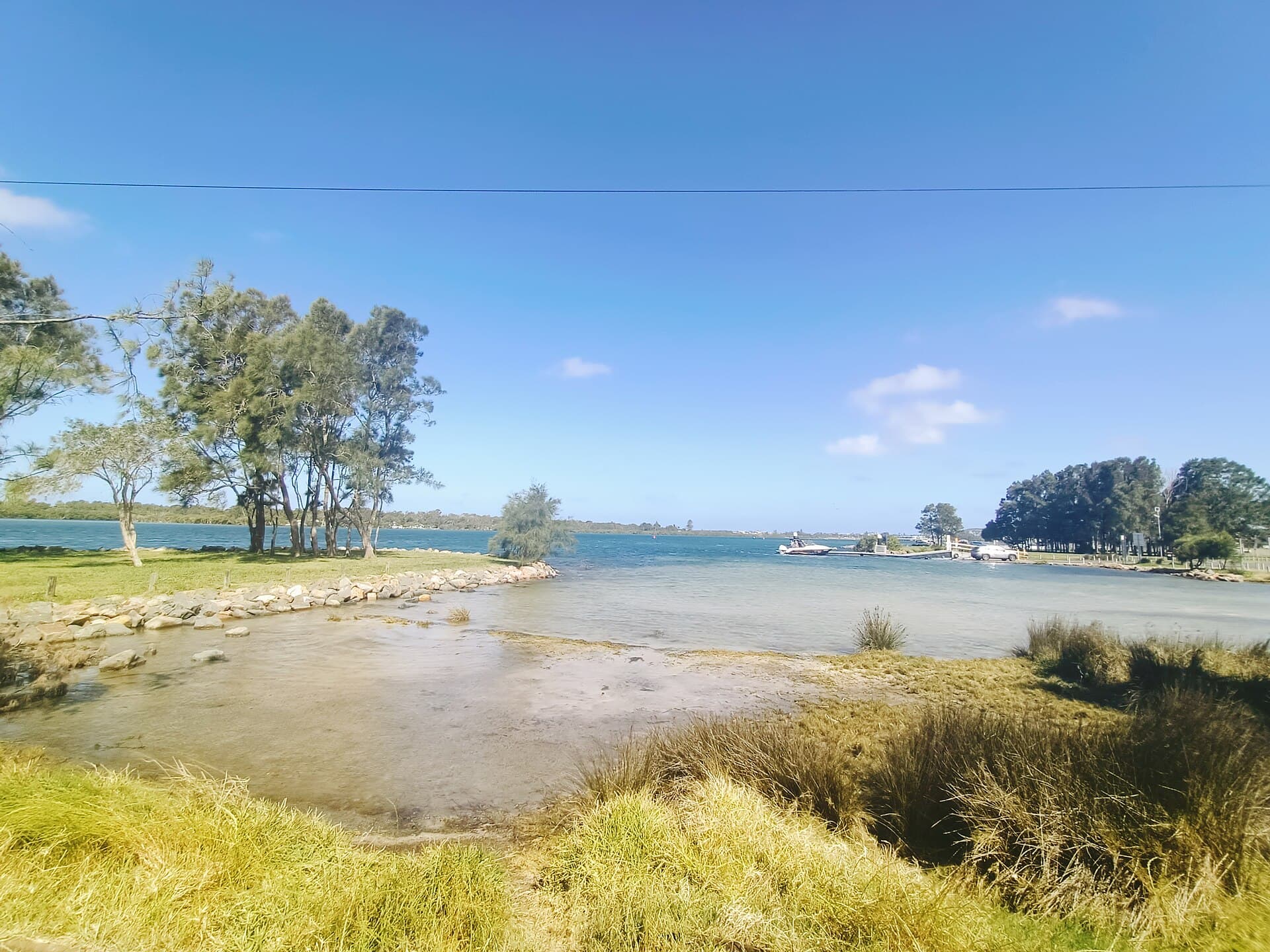
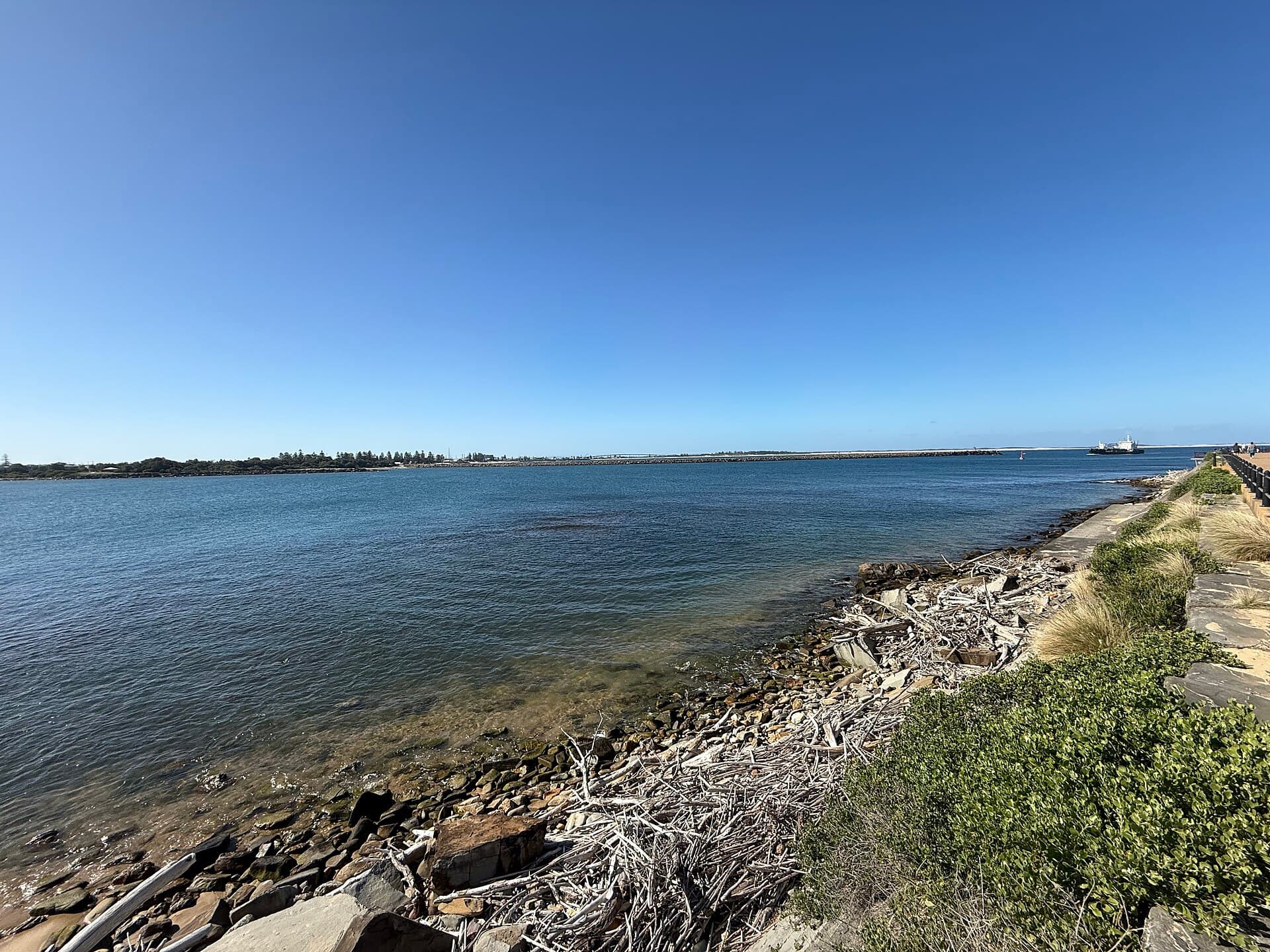
Lake glare deserves its own sentence. The eastern and northern shores — Belmont, Valentine, Warners Bay, Speers Point, the Toronto edges — get a long afternoon reflection that New Lambton never sees. Harbour-facing slabs in Newcastle East get a version of the same gift. The light is part of the specification. So is waiting for a cooler change. Do not wet the mix on the truck to “help with the heat”. Extra water is extra pores and a weaker skin. If the site is not ready at dawn, postpone. Concrete is cheaper than a mapped court you will look at for twenty years.
Colour is a summer material
Oxide and stain are pigments in a mineral field. Ultraviolet and heat do not delete them overnight. They bleach, they migrate with moisture, and they are revealed or hidden by the way the paste weathers. A rich red that looked like the sample board in the yard will go quieter on a north-facing path. A dark grey will show every tide of efflorescence — the white, chalky salts that rise with water and stay when the water leaves. Summer irrigation on one edge of a coloured slab is a good way to write a pale stripe.
This is not a reason to avoid colour. It is a reason to choose it as a weather decision. Pale greys forgive fade and glare. Deep charcoals look expensive in September and severe in February. If the court is an entertaining area, say so. The oxides and stains essay is the palette; this page says the sun will edit it. Integral colour weathers more honestly than a thin topical stain. Neither is a substitute for curing. Exposed aggregate has a summer advantage: the wear surface is stone. Pale river pebble is still kinder than dark basalt on a January afternoon by the lake.
Sealers and the ultraviolet bill
A sealer is often sold as the thing that will “lock in” the colour. Some of them do, for a time. Film-forming acrylics, the common driveway gloss, take ultraviolet personally. They chalk. They yellow. They wear on the wheel path and stay thick in the corners, so the slab ends up looking like a map of where the car does not go. On a north or west face in Newcastle that process can be a couple of summers, not a decade.
Penetrating sealers do not build a film and therefore do not chalk in the same way. They also do not give you the wet look. They cannot stop oxide from quietly fading, and they cannot undo plastic-shrinkage cracks. The sealing essay walks the product classes. Do not seal a slab that is still damp from a January storm and then park a dark car on it. Do not recoat a chalking film with another film and hope the cloudiness is “hydration”. Curing compounds are not decorative sealers, and some are incompatible with the sealer you planned for week six. Write curing and sealer as one sequence, or you will pay for both and receive neither.
What heat does after the pour
The first day is plastic shrinkage and finishing. The first week is curing: keep it moist, keep it out of the worst wind, do not let a west sun bake a skin that the interior has not caught up with. The first summer is movement. A slab on Hunter clay will dry at the edges. Joints will open. A dark driveway will run so hot that children will not sit on it, which is information you could have had in the sample yard if anyone had said it aloud.
Shade is a structural finish. A pergola, a tree that is not too close to a reactive edge, a light-coloured wall instead of a heat-bank of dark brick: these change the surface temperature more honestly than a sealer brochure. On the lake, afternoon shade is the difference between a court you use and a court you walk around.
If the slab has already mapped, be honest. Fine, shallow cracks that appeared on day one are plastic shrinkage: ugly, rarely structural. You can live with them, or grind and overlay if the base is sound — the resurfacing essay is that conversation. A faded oxide is not a failed slab. It is a mineral in the sun. Stop comparing it to the handover photograph taken at seven in the morning.
A summer briefing, in one page
Pour early or pour in a cooler week. Do not add water on site. Plan shade on exposed, dark, or waterside slabs. Cure as if the weekend depended on it. Choose colour as a fade and heat decision. Treat film-forming sealers as consumables in this ultraviolet. Walk the slab at two in the afternoon in February before you decide the job is “fine”. The crews that still start in the dark are not being precious. They have been here in January, and they remember the smell of a slab that dried too fast. You can let the weather draft the finish, or you can get up earlier.